Hurricane Season: Why the Quiet Stretch Isn’t the End of the Story
As we move through the peak of the Atlantic hurricane season, the tropics are surprisingly quiet. As of September 4, six named storms formed in 2025, and only one has strengthened into a hurricane.
Periods like this can give a false sense of security, but history shows that quiet stretches are not unusual, and certainly not a signal that the season is over. In fact, in 2022, the Atlantic went two full months without a named storm, only for activity to surge later. Similarly, in 2024, there was a late-August gap before two major hurricanes, Helene and Milton, struck in late September and October. The official season runs through November 30, and forecasters caution that the most dangerous storms often arrive after these pauses.
Why It is Happening
Meteorologists point to dry air and persistent troughing along the U.S. East Coast as limiting storm development. At the same time, Accumulated Cyclone Energy (ACE), a measure of overall storm strength and longevity, is lagging across the Atlantic and other ocean basins. If not for Hurricane Erin earlier this season, the Atlantic would be significantly below average. Current models show little risk of major storms in the next week or two, but long-range forecasts suggest the basin could become more active again by mid to late September.
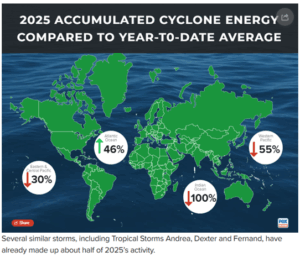
Source: Fox Weather
Beyond the Atlantic: Hurricane Lorena and Kiko Brewing
While the Atlantic is quiet, activity is building elsewhere. Hurricane Lorena was intensifying Wednesday off the coast of Mexico’s Baja California peninsula, prompting an expanded tropical storm warning. Forecasters warned of heavy rainfall of up to 15 inches (38 cm), with risks of life-threatening flash floods and mudslides, especially in mountainous areas.
Lorena, with maximum sustained winds of 80 mph (130 kph), was centered about 145 miles (230 km) west of Cabo San Lucas, moving northwest at 16 mph. Its path remained uncertain, but forecasts suggested it would track parallel to the coast, approach the peninsula late Thursday or Friday, and then turn northeast. The system was expected to weaken back to a tropical storm by Friday.
Meanwhile, Hurricane Kiko remained a Category 2 storm with sustained winds of 110 mph (175 kph) as it churned westward across the Pacific, about 1,665 miles (2,680 km) east of Hilo, Hawaii. While no watches or warnings were in effect, forecasters expected Kiko to strengthen into a major hurricane, though it posed no immediate land threat.
Seasonal Forecasts Still Point to an Active Year
Even with the quiet stretch, forecasts suggest this season is far from over.
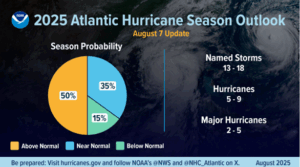
- NOAA projects 13–18 named storms, 6–10 hurricanes, and 3–2 major hurricanes by the season’s close.
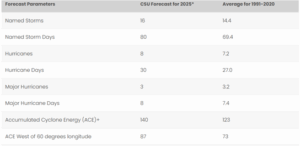
- The Colorado State University (CSU) predicts 16 named storms, 8 hurricanes, and 3 major hurricanes, noting an elevated risk for U.S. and Caribbean landfalls.
- Warm Atlantic waters and climate trends continue to fuel the risk of rapidly intensifying storms, as seen with Hurricane Erin’s brief Category 5 strength earlier this year.
Long-range hazard outlooks indicate the Atlantic could become active again by mid- to late September, just beyond the current scope of most forecast models.
Preparedness Still Matters
Even with a quiet map, it only takes one storm to make a season devastating. Forecasters remind us that the odds of another hurricane forming remain high as we move deeper into September and early October, the traditional peak of the season. Businesses that let down their guard risk being caught unprepared when activity returns. Past seasons prove that the shift from calm skies to rapid storm development can happen almost overnight.
It is also important to note that a quiet period should be viewed as an opportunity, not an endpoint. Now is the time to review emergency fuel supply plans, check backup power systems, and ensure storm readiness. Hurricane season is far from over, and preparation today could make all the difference when the next storm arrives.
Ready When It Matters Most
If you operate in a storm-prone region, now’s the time to review your emergency fuel strategy. Don’t wait for the next named storm. Reach out to Mansfield today to discuss how we can support your operations during hurricane season, and every season.
Want to learn more? In FUELSCast Episode 10, you’ll hear how Mansfield’s expert team activates a centralized strategy that collaborates across departments, and helps customers avoid panic buying by making data-informed decisions. Listen to the episode now.
This article is part of Daily Market News & Insights


MARKET CONDITION REPORT - DISCLAIMER
The information contained herein is derived from sources believed to be reliable; however, this information is not guaranteed as to its accuracy or completeness. Furthermore, no responsibility is assumed for use of this material and no express or implied warranties or guarantees are made. This material and any view or comment expressed herein are provided for informational purposes only and should not be construed in any way as an inducement or recommendation to buy or sell products, commodity futures or options contracts.