
Transportation Fuel Demand Continues to Lag Behind Pre-Pandemic Levels
Five years after the COVID-19 pandemic was declared, the demand for gasoline, diesel, and jet fuel remains below pre-pandemic averages. Several dynamics are driving this ongoing dip in demand, reflected in the measure known as product supplied. For instance, increased fuel efficiency in vehicles and aircraft has offset the rise in travel, and the demand for petroleum-based distillate fuel oil has been partially replaced by biomass-based distillate fuels. Together, these shifts highlight how structural changes in efficiency and fuel mix are reshaping long-term consumption patterns across the energy sector.
Gasoline Demand and Driving Trends
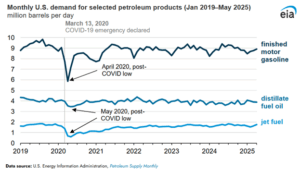
In April 2020, the first full month following the COVID-19 declaration, U.S. gasoline demand plummeted to 5.9 million barrels per day (b/d), which is the lowest since January 1974. By the following year, April 2025, U.S. gasoline demand had risen to 8.9 million b/d, 52% higher than in April 2020 but still below the April 2019 average of 9.4 million b/d. Gasoline demand gradually increased in the months following the emergency declaration.
Between 2016 and 2019, U.S. gasoline demand averaged 9.3 million b/d annually. In 2020, it fell to 8.0 million b/d before averaging 8.9 million b/d in 2023 and 2024. Increased vehicle efficiency has offset the rise in driving activity, measured as vehicle miles traveled (VMT). U.S. VMT reached an all-time high in 2024, at 9.0 billion miles per day, higher than the 2016–19 average of 8.8 billion VMT/d. However, increased fuel efficiency and the electrification of the vehicle fleet have resulted in less gasoline consumption despite increased driving activity.
Where Distillates Filled the Gaps
In May of this year, petroleum distillate fuel oil demand was 3.8 million b/d, 10% (0.3 million b/d) more than it was in May 2020, when demand for distillate fell to its lowest point following the COVID-19 declaration. Because distillate fuel oil is largely used in shipping goods and other economic activities, its consumption was less affected by COVID-19 mitigation efforts than gasoline and jet fuel, which are more closely tied to commuting and personal travel.
In 2024, petroleum distillate demand averaged 3.8 million b/d, less than the 4.1 million b/d consumed in 2019. The primary cause for this decline was the substitution of petroleum diesel with biofuels, namely renewable diesel, which has gained a larger market share of the diesel pool due to clean-fuel programs that provide incentives for biofuels. In 2019, only 110,000 b/d of renewable diesel and biodiesel were consumed, whereas in 2024, 310,000 b/d were consumed. Including biodiesel and renewable diesel, total distillate demand in 2024 was closest to pre-pandemic levels, at only 1% below 2019 distillate demand.
The Climbing Demand of Jet Fuel
Along with distillate fuel, jet fuel demand continued its upward trend in May. U.S. jet fuel demand averaged 1.8 million b/d, significantly more than in May 2020, when demand fell to 597,000 b/d, the lowest since May 1968. In the three years prior to the pandemic, jet fuel demand gradually increased. However, jet fuel demand has not returned to pre-pandemic levels in part because the fleet of aircraft has become more efficient, and in 2024, jet fuel demand was 3% below 2019 levels. In 2024, data from the Bureau of Transportation Statistics indicate the number of passengers and the available seat miles, a measure of aircraft carrying capacity, both increased from 2019, although the total number of flights decreased. Efficiency gains and changing flight patterns, among other factors, have contributed to jet fuel consumption remaining slightly lower than pre-pandemic levels.
This article is part of Daily Market News & Insights


MARKET CONDITION REPORT - DISCLAIMER
The information contained herein is derived from sources believed to be reliable; however, this information is not guaranteed as to its accuracy or completeness. Furthermore, no responsibility is assumed for use of this material and no express or implied warranties or guarantees are made. This material and any view or comment expressed herein are provided for informational purposes only and should not be construed in any way as an inducement or recommendation to buy or sell products, commodity futures or options contracts.