

Federal Onshore Crude Production Surges with Permian Basin at the Forefront
U.S. crude oil production on federal onshore lands is seeing record-setting momentum, with 2024 output reaching an all-time high of 1.7 Mbpd, a sixfold increase from 2008 levels, according to data from the U.S. Department of the Interior’s Office of Natural Resources Revenue and the EIA.
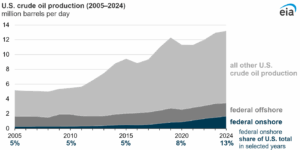
Much of this growth stems from federal acreage in New Mexico’s Permian Basin, where drilling activity has increased. Over the past several years, the state has led in drilling permits, lease approvals, and well-bore starts on federal land, trends that signal strong upstream investment and supply resilience in the region.
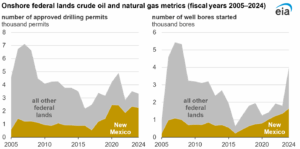
The recent jump in federal onshore production is part of a broader trend – tight oil production from the Permian Basin is the primary driver of U.S. Lower 48 onshore crude oil growth. Since 2010, tight oil output has grown from 0.8 Mbpd to 8.9 Mbpd, now accounting for 81% of all Lower 48 onshore oil production. Over half of that production came from the Permian in 2024.
While legacy vertical wells have declined over time, horizontal drilling in the Permian has powered sustained growth. After a brief dip during the 2020 COVID-related price collapse, production in the Permian rebounded quickly, rising 45% between 2020 and 2024, while non-Permian tight oil volumes fell nearly 15%. The Wolfcamp formation alone produced 3.4 million b/d in 2024, matching output from all non-Permian tight oil plays combined.
While total U.S. crude oil production rose to 13.2 Mbpd in 2024, nearly triple the 2008 level, federal onshore volumes have grown at an even faster pace. In contrast, federal offshore production, which includes the Gulf of Mexico, remains slightly higher at 1.8 Mbpd, but its growth has been more modest.
Natural gas output from onshore federal lands has also picked up. Production increased from 3.2 trillion cubic feet (Tcf) in 2020 to 4.2 Tcf in 2024. During the same period, total U.S. dry natural gas production grew from 33.8 Tcf to 37.8 Tcf, with the federal onshore share inching up from 9.6% to 11.0%. This shift marks a notable reversal from the long-standing decline in the federal government’s share of national gas output.
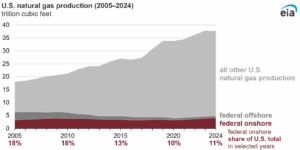
Meanwhile, federal offshore natural gas production continues to decline, falling to just 0.8 Tcf in 2024—less than one-third of what was produced in 2005.
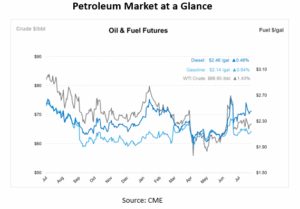
This article is part of Daily Market News & Insights
Tagged: Crude Production Surges, Federal Onshore, Permian Basin, U.S.


MARKET CONDITION REPORT - DISCLAIMER
The information contained herein is derived from sources believed to be reliable; however, this information is not guaranteed as to its accuracy or completeness. Furthermore, no responsibility is assumed for use of this material and no express or implied warranties or guarantees are made. This material and any view or comment expressed herein are provided for informational purposes only and should not be construed in any way as an inducement or recommendation to buy or sell products, commodity futures or options contracts.