

Oil Prices Slip as Tariffs, OPEC+ Output, and Supply Tightness Shape the Market
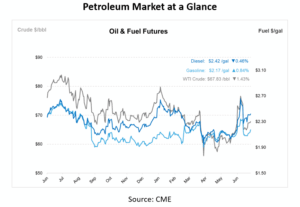
Oil prices are slipping this week after a brief rally, as global markets respond to a mix of economic signals, geopolitical risks, and shifting supply dynamics. Both Brent and West Texas Intermediate (WTI) crude are trading lower this morning, reversing some of the previous session’s gains. Brent crude is currently priced at $69.59 per barrel, while WTI has dropped to $67.83 per barrel. This pullback comes amid growing concerns about U.S. tariff policy, rising OPEC+ production, and tight diesel supplies heading into the summer.
The Trump administration’s extension of the July 9th tariff deadline to August 1st is impacting market sentiment this week. While the delay postponed immediate action, it was accompanied by letters sent to trading partners, including Japan, South Korea, and Kazakhstan, warning of sharply higher tariff rates ranging from 25% to 40%. If enacted, these tariffs would raise the U.S. effective tariff rate by 1.4 percentage points. Although analysts at Goldman Sachs Research believe most of these rates are unlikely to be implemented, the threat has created renewed market uncertainty. This trade policy shift is adding pressure on U.S. partners and raising concerns about potential impacts on global economic activity and fuel demand.
Meanwhile, in the Red Sea, tensions continue to rise following another Houthi attack on a commercial vessel on Monday. The incident, which occurred just hours after an earlier attack in the same area, caused significant damage and added another layer of geopolitical risk to an already fragile energy market.
At the same time, the oil market is seeing some notable changes. Over the weekend, the OPEC+ alliance agreed to raise production by 548,000 barrels per day starting in August, an increase above the 411,000 BPD hikes seen in the past three months. This decision follows a gradual reversal of the 2.2 million BPD of voluntary production cuts made by the group since 2023. Sources have indicated that another similar increase could be approved at the next meeting on August 3, which would fully unwind those earlier cuts. While the market has welcomed higher output during peak demand season, analysts warn that the added supply could pressure prices once demand begins to taper in the fall. Some forecasts suggest Brent prices could fall to $65 per barrel in the coming months due to the risk of oversupply.
Despite the rising crude output, the diesel market is showing signs of strain. U.S. diesel inventories have fallen to their lowest level for this time of year since 1996, driven by refinery closures in the U.S. and Europe and a series of operational outages. Diesel yields have also dropped, accounting for just 31.4% of global oil product output – below typical seasonal averages. As a result, diesel prices have risen relative to crude, particularly in regions like the U.S. East Coast, where demand is high and infrastructure is under pressure. In response, a major East Coast gasoline pipeline has temporarily increased its capacity by 5% to 7% above normal summer levels to help meet fuel needs during the travel season.
On the trading side, market participants are adjusting their positions based on evolving fundamentals. Throughout last Tuesday, managed money net length in WTI crude rose by 13,100 contracts, supported by an increase in long positions and a reduction in short positions. In contrast, Brent crude saw a significant pullback, with net length falling by 24,000 contracts due to a steep decline in long positions. NYMEX gasoline and heating oil also saw declines in net length, reflecting cautious sentiment among traders.
While the market is contending with the immediate impact of tariff threats and geopolitical tensions, price action is also being shaped by technical factors. Analysts note that WTI appears to have support around $67.71 per barrel and may attempt to retest resistance near $68.12. If current patterns hold, prices could climb toward $68.96 in the short term, though a break below $67.17 could pull the market down into the $66.23 to $66.75 range. On a daily chart, WTI broke past a key resistance level at $66.85, which could open the door to further gains toward the $69.50 mark, a common retracement target based on earlier highs.
This article is part of Daily Market News & Insights
Tagged: brent, commodity trading, crude oil, Diesel Supply, energy market, fuel-demand, gasoline pipeline, Global Oil Market, managed money, market sentiment, Oil futures, oil inventory, oil prices, opec, Red Sea attacks, Refinery closures, summer fuel demand, Trump administration, U.S. Tariffs, WTI


MARKET CONDITION REPORT - DISCLAIMER
The information contained herein is derived from sources believed to be reliable; however, this information is not guaranteed as to its accuracy or completeness. Furthermore, no responsibility is assumed for use of this material and no express or implied warranties or guarantees are made. This material and any view or comment expressed herein are provided for informational purposes only and should not be construed in any way as an inducement or recommendation to buy or sell products, commodity futures or options contracts.