

NOAA and CSU Warn of Active Hurricane Season. Is Your Fuel Plan Ready?
The 2025 Atlantic hurricane season officially begins on June 1 and continues through November 30, and early forecasts suggest it could be more active than usual. Both NOAA and Colorado State University (CSU) are predicting a higher-than-average number of storms, raising concerns for businesses located in hurricane-prone regions, particularly those that depend on diesel fuel for operations or backup power.
NOAA expects 13 to 19 named storms this year, with 6 to 10 becoming hurricanes and 3 to 5 reaching major hurricane status (Category 3 or higher). That’s significantly above the 30-year average of 14 named storms and 3 major hurricanes. There’s a 60% chance of an above-normal season and only a 10% chance of a quieter one.
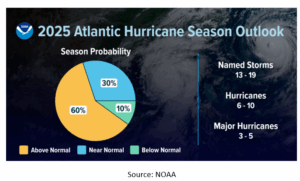
CSU’s forecast aligns closely, projecting 17 named storms, 9 hurricanes, and 4 major hurricanes. While exact landfall predictions aren’t possible, the probability of at least one major hurricane striking the U.S. is higher than usual, especially along the Gulf Coast and in the Caribbean. Their 2025 report also includes updated landfall probabilities for major hurricanes:
- 51% chance of a major hurricane striking the entire U.S. coastline (historic average: 43%)
- 26% for the U.S. East Coast, including the Florida peninsula (average: 21%)
- 33% for the Gulf Coast from the Florida Panhandle to Brownsville, TX (average: 27%)
- 56% for the Caribbean (average: 47%)
Several climate conditions are contributing to this outlook. Ocean waters are warmer than average, and atmospheric wind shear is expected to remain weak, both of which make it easier for tropical storms to grow into powerful systems. Forecasters also point to a potential northward shift in the West African Monsoon, which often initiates strong and long-lived Atlantic storms. Meanwhile, uncertainty around the El Niño–Southern Oscillation (ENSO) adds another layer of unpredictability, though current signals support increased storm activity.
This year continues a decade-long trend of above-average hurricane seasons. The last below-normal season was in 2015. Since then, Atlantic storms have grown more frequent and more intense, with 2020’s record-breaking 30 named storms still fresh in many memories. Even quieter years like 2022 still produced more storms than the long-term average.
A Look Back at 2024
Last year’s hurricane season serves as a clear reminder of the dangers these storms pose. The 2024 Atlantic hurricane season saw 18 named storms, 11 of which became hurricanes—well above the long-term average. According to the National Hurricane Center, it was the deadliest U.S. hurricane season since 2005, with over 400 total fatalities.
Hurricane Helene was especially devastating, claiming at least 241 lives across the continental U.S., making it the deadliest single storm since Hurricane Katrina. Financially, 2024 was the third-costliest hurricane season on record, trailing only 2017 and 2005. These events left lasting impacts on power grids, transportation, fuel availability, and infrastructure across affected regions.
Why Fuel Readiness Matters
For businesses that depend on diesel fuel—whether to operate fleets, run critical machinery, or power backup generators—storms like those in 2024 expose how vulnerable fuel access can become. After major hurricanes, road closures, power outages, and fuel supply disruptions are common. Fuel terminals may shut down, delivery routes can be blocked, and retail fuel stations often run dry.
Having a strategy in place ahead of time can prevent costly downtime. Businesses should evaluate on-site fuel storage, verify contracts with emergency fuel suppliers, and test backup generators well before a storm is on the radar.
Here are some ways to ensure you’re ready:
- Create an Emergency Plan – Have a plan to minimize the risk of business disruptions. It should include temporary storage tanks, dedicated fuel supply trucks and priority/emergency supply, and proactive tank and generator maintenance – in case a storm hit.
- Follow Official Weather Updates – The National Hurricane Center and local meteorologists provide real-time forecasts and alerts.
- Stay Connected – Follow emergency management agencies on social media for up-to-date guidance. Also, you must stay in contact with your fuel supplier to get updates about any changes in their delivery schedules.
Although forecasts don’t predict exactly where storms will make landfall, the outlook for 2025 suggests an increased likelihood of impactful hurricanes. With the first named storm expected to be Andrea, businesses in vulnerable areas should act now—before the season peaks in September.
Proactive planning is critical to maintaining continuity and keeping operations running, no matter what the season brings. You can learn more on how to weather-proof your fuel supply here.
Talk to the experts
Mansfield, North America’s leading fuel distributor, brings a wealth of expertise to creating a robust emergency response program tailored to your company’s needs. With an extensive network servicing the US and Canada, Mansfield understands the critical importance of proactive measures in facing potential disruptions caused by hurricanes or other natural disasters.
Leveraging in-depth knowledge, Mansfield has developed a comprehensive Emergency Response Fuel Program that prescribes industry best practices. Mansfield’s program enables a multi-faceted approach, prioritizing essential services and collaborating closely with partners to ensure seamless fuel distribution during emergencies. Contact us today!
This article is part of Daily Market News & Insights
Tagged: 2024 Atlantic Hurricane Season, Atlantic storms, CSU forecast 2025 report, Emergency Response Fuel Program, emergency weather, hurricane season 2025, hurricane status, hurricanes, National Hurricane Center, NOAA, NOAA and CSU, Severe Weather Fuel Strategy, U.S. hurricane season, weather predictions


MARKET CONDITION REPORT - DISCLAIMER
The information contained herein is derived from sources believed to be reliable; however, this information is not guaranteed as to its accuracy or completeness. Furthermore, no responsibility is assumed for use of this material and no express or implied warranties or guarantees are made. This material and any view or comment expressed herein are provided for informational purposes only and should not be construed in any way as an inducement or recommendation to buy or sell products, commodity futures or options contracts.