

OPEC+ Uncertainty and Geopolitical Tensions Keeping Oil Prices in Check
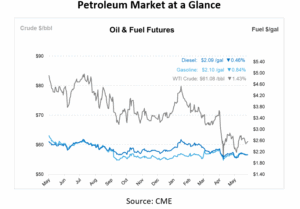
After a long holiday weekend, oil markets returned to trading under bearish pressure. Prompt crude futures slipped by $0.45/bbl, extending last week’s declines. The drop was largely attributed to light post-holiday trading volumes following Memorial Day in the U.S. However, traders are also showing restraint ahead of key geopolitical and market events, particularly the OPEC+ meeting now rescheduled to May 31—more than a month earlier than originally planned.
The meeting is expected to center around production decisions for July, with some speculation of a 411,000 bpd output hike. Yet, Russia has pushed back on those expectations. Deputy Prime Minister Alexander Novak stated that the group has not discussed a quota increase, reiterating that no adjustments are being made beyond the voluntary cuts agreed upon by eight countries in 2023. Even with Western sanctions and potential price cap changes, Russia confirmed its crude export levels would remain stable. This hesitancy has added to the market’s uncertainty and kept oil prices from gaining much ground.
Political developments are adding further complexity. President Trump extended tariff negotiations with the European Union until July 9, temporarily alleviating fears of imminent trade disruptions. Still, the possibility of new sanctions against Russia, as well as China’s response to U.S. tariff rollbacks, particularly from plastics manufacturers, has dampened hopes for a quick improvement in global trade flows. Meanwhile, Iranian President Masoud Pezeshkian announced that Iran could weather failed nuclear talks, which raises the likelihood of continued sanctions limiting Iran’s oil exports, providing a potential price floor.
From a macroeconomic standpoint, Goldman Sachs Research (GIR) reaffirmed its bearish outlook on crude for the next two years, forecasting WTI at $56/bbl in 2025 and $52 in 2026. These projections reflect an expected jump in non-OPEC supply, which may keep markets well-stocked. However, Goldman sees a more bullish case for oil prices beyond 2026, assuming tighter supply conditions emerge. On the inflation front, Goldman also predicted a temporary rise in U.S. core PCE to 3.6% later this year due to tariffs, but expects inflation to ease and rate cuts to follow as long as trade tensions do not escalate further.
President Trump signed a suite of executive orders aimed at boosting the U.S. nuclear energy sector. These include measures to simplify permitting, support advanced reactor technologies, and modernize regulatory frameworks. While not directly tied to oil, this push signals a broader shift in U.S. energy strategy and could influence long-term fossil fuel demand.
On the supply side, rig counts in the U.S. continue to decline. The total number of oil-focused rigs fell by eight last week, dropping the national count to 465—the lowest since November 2021 and down 32 rigs year-over-year. The Permian Basin alone has lost 34 rigs over the past year, with smaller declines seen in the Bakken and Eagle Ford basins. Industry watchers attribute this trend largely to private operators reacting quickly to recent price volatility, including WTI briefly dipping below $60. Natural gas rigs also declined by two, while the combined U.S. oil and gas rig count fell by two to 563, according to Baker Hughes data.
This article is part of Daily Market News & Insights


MARKET CONDITION REPORT - DISCLAIMER
The information contained herein is derived from sources believed to be reliable; however, this information is not guaranteed as to its accuracy or completeness. Furthermore, no responsibility is assumed for use of this material and no express or implied warranties or guarantees are made. This material and any view or comment expressed herein are provided for informational purposes only and should not be construed in any way as an inducement or recommendation to buy or sell products, commodity futures or options contracts.