

Oil Prices Rebound on US-China Truce
Crude oil prices are climbing this week as markets digest a series of major geopolitical and economic developments. The most significant driver is the recent de-escalation of the U.S.-China trade war, which helped lift market sentiment and temporarily reduced fears of a global recession. At the same time, rising crude exports from OPEC+ nations and a mixed demand outlook are keeping price gains in check.
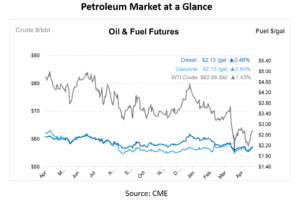
This morning, Brent crude is trading around $65.61 per barrel, up nearly 1%, while U.S. West Texas Intermediate (WTI) is at $62.67, gaining 72 cents on the day. These gains extend a rally that began on Monday, when prices surged more than 4% following the surprise announcement of a 90-day tariff rollback between the United States and China.
The temporary pause in tariff escalation marks the first significant breakthrough in U.S.-China trade relations since President Trump’s return to office. The U.S. agreed to reduce tariffs on Chinese goods from 145% to 30%, while China cut duties on U.S. imports from 125% to 10%. While this truce only lasts 90 days, it has already reshaped the economic outlook.
Goldman Sachs Research responded by lowering the probability of a U.S. recession over the next 12 months from 45% to 35% and raising its 2025 U.S. GDP growth forecast to 1%, up from 0.5%. The firm also revised its China GDP forecast for 2025 from 4.0% to 4.6%, citing improved trade conditions.
Despite this optimism, analysts caution that the current tariff relief is limited and unlikely to revive U.S. energy exports to China in the short term. As of now, no U.S. crude shipments are expected to reach Chinese ports in May, and liquefied natural gas (LNG) and coal flows remain halted.
In a parallel development, President Trump arrived in Saudi Arabia for a four-day visit focused on expanding U.S.-Saudi economic cooperation. The visit comes as Saudi Arabia, a key OPEC+ member, continues to increase oil production to discipline non-compliant members and stabilize global markets.
The Trump administration is expected to announce a new deal that will expand Saudi access to U.S. semiconductor technology, helping the Kingdom scale up its data center infrastructure. The trip also includes discussions around nuclear energy collaboration and investment opportunities, with a goal of securing up to $1 trillion in commitments from Saudi partners.
Analysts note that oil pricing may not be the main focus of the trip, but Saudi Arabia’s increased exports, especially to China, are shaping the current price environment. In May and June, Aramco is shipping about 48 million barrels per month to China, its highest level in over a year.
On the supply front, OPEC+ production is on the rise, with eight member nations, including Saudi Arabia and Russia, set to add 411,000 barrels per day (bpd) in June. Saudi Aramco, in particular, is maintaining elevated export levels to China, shipping about 48 million barrels per month, its highest in over a year.
In contrast, Mexico plans to reduce crude exports as its latest refinery ramps up capacity to 340,000 bpd, pushing more supply to domestic use. Similarly, Kazakhstan’s CPC terminal on the Black Sea is undergoing maintenance, cutting exports by 100,000 bpd in May.
Russia’s oil export revenues have also slumped, falling for the fifth week in a row. Although export volumes edged up to 3.42 million bpd, the value of those exports remains at a nearly two-year low due to weaker pricing.
While refining margins and fuel demand have held steady, global oil demand growth is slowing, according to J.P. Morgan. Their analysts report that oil demand in early May averaged 103.5 million bpd, which is just 280,000 bpd higher than a year ago, well below the expected growth of 550,000 bpd for the month.
Nonetheless, the bank expects demand to rise in the coming weeks with the start of the summer driving season. However, OECD commercial oil stocks are increasing, driven largely by a 26-million-barrel crude stock build in China, signaling possible oversupply risks if demand does not strengthen quickly.
In the U.S., consumer prices rose 0.2% in April, with energy and food contributing to the modest gain. Economists expect inflation to increase through the rest of 2025, though at a slower pace than previously feared due to the trade truce. Core CPI is projected to hit 3.5% by year-end, slightly above the Federal Reserve’s 2% target but manageable enough for the Fed to maintain its current interest rate policy for now.
In Canada, Alberta has capped industrial carbon taxes at C$95 per ton, halting a scheduled increase to C$110. The move aims to provide cost certainty to the oil, gas, and petrochemical sectors amid rising global trade tensions and U.S. tariffs.
Oil prices are rising, but markets remain on edge. A temporary U.S.-China trade truce and a high-stakes visit to Saudi Arabia have calmed near-term volatility, but rising OPEC+ production and sluggish demand could cap further gains. While Brent sits around $65 per barrel, stakeholders are watching upcoming global developments – especially the outcome of Trump’s visit to Riyadh and ongoing trade negotiations – for further direction.
This article is part of Daily Market News & Insights
Tagged: Brent Crude, China GDP, Crude Oil Market, Energy Market Outlook, Global oil demand, Global Supply Chain, Goldman Sachs Forecast, Inflation and Oil, oil exports, oil prices, Oil Tariffs, OPEC production, President Trump Saudi Visit, Refining Margins, Tariff Reduction, U.S. Economic Growth, U.S. Energy Exports, U.S.-China Trade Deal, wti crude


MARKET CONDITION REPORT - DISCLAIMER
The information contained herein is derived from sources believed to be reliable; however, this information is not guaranteed as to its accuracy or completeness. Furthermore, no responsibility is assumed for use of this material and no express or implied warranties or guarantees are made. This material and any view or comment expressed herein are provided for informational purposes only and should not be construed in any way as an inducement or recommendation to buy or sell products, commodity futures or options contracts.