

Renewable Fuels: What’s Driving the Market Shake-Up?
Renewable diesel (RD) consumption continues to rise on the U.S. West Coast, largely driven by state-level clean fuel programs in California, Oregon, and Washington, according to the U.S. Energy Information Administration (EIA). However, recent disruptions in production and imports have tightened supply, leading to sizable cost increases for renewable diesel.
Supply Challenges and Market Adjustments
While RD production on the West Coast had been on a strong growth trajectory, recent developments have significantly impacted supply availability. Neste, the largest importer of renewable diesel into the U.S., halted imports this past fall due to poor market economics. Shortly after, Chevron switched production at its El Segundo, CA refinery from renewable diesel back to CARB diesel. Additionally, Diamond Green converted some of its renewable diesel production to sustainable aviation fuel, with portions of that production expected to be exported. Most recently, Marathon announced planned downtime at both of its U.S. renewable diesel plants, further tightening supply.
These supply reductions stem from economic challenges rather than a lack of production capacity. The expiration of the $1.00 per gallon blenders tax credit (BTC) at the end of 2024 removed a key financial incentive that helped keep renewable diesel and biodiesel competitive. Without this subsidy, production costs for renewable fuels in many cases exceed those of standard diesel, making it less viable for producers to continue manufacturing at previous levels.
With both domestic production and imports declining, renewable diesel prices have risen sharply. The impact has been more pronounced than for biodiesel, as biodiesel is typically blended into conventional diesel at lower percentages, whereas renewable diesel is used as a full substitute. The reduction in available supply has also put additional pressure on other biofuels, leading to increased costs across the board.
West Coast Market Trends
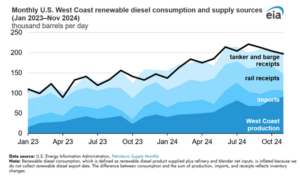
EIA data shows that renewable diesel production on the West Coast exceeded 90,000 barrels per day (b/d) in November 2024—nearly four times the volume recorded in early 2023. This accounted for about 45% of the region’s renewable diesel consumption. The remaining demand was met through interregional rail shipments (20%), tanker and barge shipments (25%), as well as imports and inventory draws.
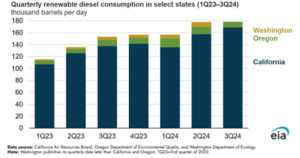
California remains the largest consumer of renewable diesel, where it made up nearly 65% of transportation distillate fuel in the third quarter of 2024. This was a slight decrease from 70% in the second quarter, with biodiesel contributing an additional 5%.
In Oregon, biofuels accounted for about a quarter of transportation distillate consumption in the third quarter, with renewable diesel making up roughly twice the share of biodiesel. Washington also saw increased adoption, where biofuels comprised 20% of transportation distillate fuel in the second quarter of 2024, with over 15% coming from renewable diesel.
Growing National Demand
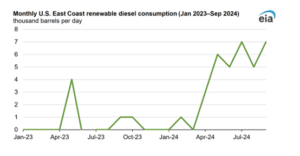
While the West Coast remains the primary market for renewable diesel, the EIA notes that consumption is also increasing in other regions. The U.S. East Coast has become a more consistent destination for shipments, with consumption ranging from 5,000 to 7,000 b/d between May and September 2024. New Jersey accounted for about two-thirds of these imports.
In 2024, the East Coast began consuming small volumes of renewable diesel, marking a major shift in the region’s energy landscape and positioning the East Coast as a hub for renewable diesel consumption. This progress is primarily driven by initiatives from select suppliers and local governments to promote and adopt this alternative fuel. Since renewable diesel is not produced on the East Coast, suppliers and local governments source their imports and shipments from other regions of the United States and globally to meet the demand.
The East Coast now accounts for nearly 10% of the United States’ renewable diesel inventories and attracts a similar percentage of the country’s supply. While the effect of the East Coast’s renewable diesel consumption on national and international markets has been minimal compared to other regions, its impact is major.
Several Northeastern states are considering clean fuel programs, which, if enacted, could further boost renewable diesel consumption. Despite these advancements, challenges persist, including infrastructure limitations, like the scarcity of Jones Act-compliant vessels required for shipping goods between U.S. ports, and policy uncertainty, with no active clean fuel programs currently in place on the East Coast. Ongoing infrastructure developments, strategic partnerships, and potential policy changes point to the trajectory for renewable diesel in the region’s energy future.
This article is part of Daily Market News & Insights
Tagged: Alternative Fuels, biofuels, California Energy, Carbon Reduction, Clean Energy, diesel prices, East Coast Energy, East Renewable Diesel, Energy Infrastructure, Energy Policy, Energy Transition, fuel market, fuel supply, Oregon clean Fuel, Refinery Updates, renewable diesel, renewable energy, Renewable Fuel Standard, Sustainable Fuels, transportation fuels, Washington Renewable Fuel, West Coast Energy


MARKET CONDITION REPORT - DISCLAIMER
The information contained herein is derived from sources believed to be reliable; however, this information is not guaranteed as to its accuracy or completeness. Furthermore, no responsibility is assumed for use of this material and no express or implied warranties or guarantees are made. This material and any view or comment expressed herein are provided for informational purposes only and should not be construed in any way as an inducement or recommendation to buy or sell products, commodity futures or options contracts.